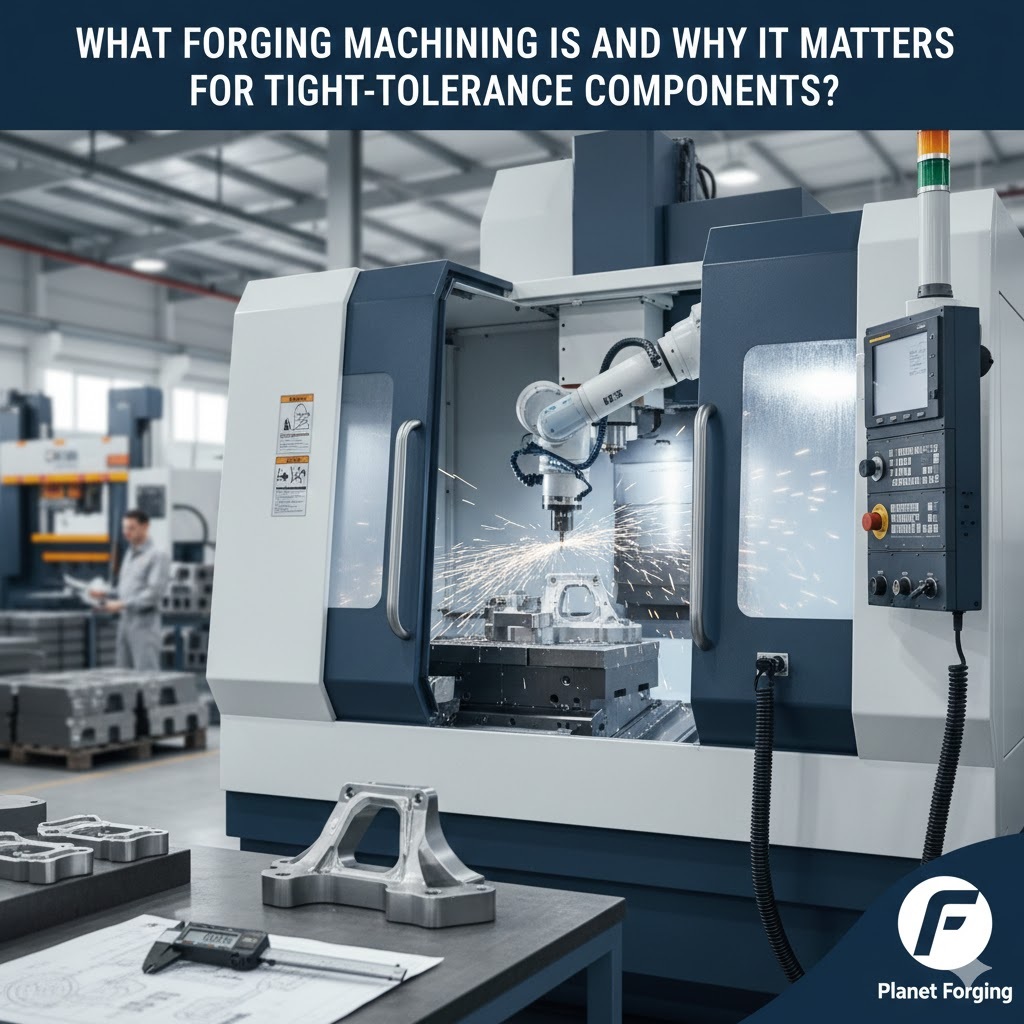
Precision is not a preference in industrial manufacturing. It is a requirement. When parts run out of tolerance, machines vibrate. When machines vibrate, they wear. When they wear, they fail. Tight-tolerance components do not forgive shortcuts, and they do not hide mistakes. This is exactly where forging machining proves its value.
Forging machining is not a buzzword. It is the disciplined combination of structural forging and controlled machining, designed to produce parts that are not only strong, but exact. This process exists for one reason: to create components that survive heavy load while holding microns where it matters.
Where Forging Ends and Machining Begins
Forging gives shape. Machining gives accuracy. Forging builds the structure. Machining finishes the geometry.
In forging machining, the metal is first forged close to final shape, with grain flow aligned to the part geometry. Then machining is applied only where precision is critical. No unnecessary material removal. No cutting through load paths. No weakening the structure.
This is not about convenience. This is about control.
When machining is done on forged stock, the internal grain structure remains intact around critical zones. Threads, bearing seats, sealing faces, and alignment surfaces are cut into a body that already carries directional strength. The result is a part that holds tolerance without sacrificing durability.
Why Tight Tolerance Needs Structural Integrity
Tolerance alone is meaningless if the part cannot hold it under load.
A perfectly machined part made from weak or unstable material will drift. Heat will move it. Stress will distort it. Vibration will destroy it.
Forged material does not behave that way.
Because the grain is continuous and compacted, forged parts resist distortion. When machining is applied on this stable base, the finished dimensions stay where they were put. This is why forging machining is trusted for components that must remain accurate under pressure.
Bearings stay aligned. Seals stay seated. Gears stay meshed.
Precision survives because the structure supports it.
Grain Flow and Machined Surfaces Working Together
Machining removes material. That is unavoidable. The danger is where that removal happens.
When parts are machined from bar stock, grain is cut across. The structure is interrupted. Stress risers are created. Fatigue life is reduced.
In forged parts, grain flows around the geometry. When machining is applied, it cuts into a structure that is already shaped to carry load. This preserves strength around critical features such as:
- Threads
- Keyways
- Splines
- Bearing journals
- Seal grooves
This is the core advantage of forging machining. Precision is achieved without weakening the part.
Dimensional Stability Under Real Operating Conditions
Parts do not fail in inspection rooms. They fail in heat, pressure, vibration, and shock.
Forged material has lower residual stress. Heat treatment stabilizes the structure. This stability means the part does not creep, warp, or relax over time.
When machining is done on stable forged stock, the final dimensions remain stable in service. This is essential for tight-tolerance assemblies where even small movement creates big problems.
Hydraulic systems, transmission assemblies, steering systems, and rotating equipment depend on this stability. Once tolerance is lost, damage accelerates.
Forging machining exists to prevent that slide into failure.
Reduced Machining, Reduced Risk
Heavy machining increases risk. It cuts through grain. It introduces stress. It creates sharp transitions. It removes strength.
Forging brings the shape close to final. Machining becomes minimal. This preserves internal structure and reduces the chance of distortion.
Less cutting means:
- Fewer stress risers
- Better fatigue life
- Lower chance of dimensional drift
- Higher structural reliability
This is not theory. It is visible in service life.
Surface Finish That Actually Holds
Tight tolerance is not only about dimension. It is about surface.
Bearing seats, sealing faces, and sliding surfaces must be smooth, consistent, and stable. Forged material supports this because the underlying structure is dense and uniform.
When machining is applied, the surface finish holds. It does not break down. It does not pit easily. It does not flake.
This matters in high-pressure systems where leakage is not tolerated and friction is destructive.
With forging machining, the surface is not just accurate on day one. It stays accurate.
Process Discipline at Sendura Forge Pvt. Ltd.
Precision does not happen by accident. It is controlled.
At Sendura Forge Pvt. Ltd., forging and machining are treated as one continuous process, not two separate steps. Die design accounts for machining allowances. Deformation is controlled to protect critical zones. Heat treatment is calibrated for stability before machining begins.
This integration ensures that when machining is applied, it is cutting into a structure that is ready to hold tolerance.
No surprises. No weak zones. No hidden distortion.
The result is components that remain accurate under real operating stress.
Tight Tolerance in Load-Bearing Zones
Some areas of a component carry more responsibility than others.
Bearing seats. Mounting faces. Alignment bores. These zones cannot move. They cannot oval. They cannot relax.
Forged structure supports these zones. Machining defines them.
This combination is why forging machining is used in:
- Gearbox housings
- Steering knuckles
- Suspension components
- Hydraulic manifolds
- Drive train parts
In these applications, tolerance is not about fit. It is about survival.
Vibration Control Through Structural Accuracy
Vibration is a symptom. It indicates imbalance, misalignment, or distortion.
Tight tolerance alone does not solve vibration. Structural stability does.
Forged parts resist distortion. Machined features stay aligned. This reduces imbalance and keeps rotating assemblies smooth.
Lower vibration means:
- Longer bearing life
- Reduced fatigue
- Quieter operation
- Less secondary damage
This is how precision becomes longevity.
Fatigue Resistance in Machined Features
Threads and grooves are common failure points. They concentrate stress. They invite cracks.
In forged parts, grain flows around these features. When machining creates them, they are surrounded by supportive structure instead of cut grain ends.
This increases fatigue life dramatically.
It is one of the least discussed but most valuable advantages of forging machining.
Thermal Stability and Tolerance Retention
Temperature changes move metal. That is unavoidable.
Forged material moves predictably. Machined features stay aligned because the underlying structure expands evenly.
This is critical in engines, compressors, and high-temperature assemblies where thermal cycling is constant.
Tolerance that cannot survive heat is not tolerance. It is illusion.
Traceability and Quality Control at Sendura Forge Pvt. Ltd.
Material traceability, dimensional inspection, and mechanical verification are not formalities. They are safeguards.
Each stage of forging and machining is monitored. Each batch is documented. Each critical dimension is verified.
This discipline ensures that tight tolerance is not a gamble. It is a guarantee.
Lifecycle Impact of Forging Machining
Precision reduces wear. Structural integrity prevents distortion. Together, they extend life.
Components last longer. Assemblies stay aligned. Systems run smoother.
Downtime decreases. Maintenance becomes predictable. Risk drops.
Choosing forging machining is not about perfection. It is about control.
Control over geometry. Control over structure. Control over performance.
Where Forging Machining Makes the Difference
This process is not used for decoration. It is used where failure costs.
Heavy equipment. Automotive systems. Industrial machinery. Power transmission.
Anywhere a part must be both strong and exact, forging machining is the solution.
Conclusion
Tight tolerance without strength is fragile. Strength without precision is useless.
Forging machining delivers both.
Forged structure provides the backbone. Machining delivers the accuracy. Together, they create components that hold shape, hold load, and hold life.
In environments where machines are pushed, precision is tested, and failure is expensive, this process is not optional.
It is essential.