The Quantum Pillar: Understanding Quantum Key Distribution (QKD)
In an age where data breaches and cyberattacks make daily headlines, the quest for truly secure communication has become paramount. Enter Quantum Communication—a revolutionary field leveraging the bizarre laws of quantum mechanics to transmit information in ways once thought impossible. Unlike classical communication, which can be intercepted and copied, quantum communication offers a foundation for security rooted in the fundamental laws of physics, promising a new era of privacy for governments, financial institutions, and individuals.
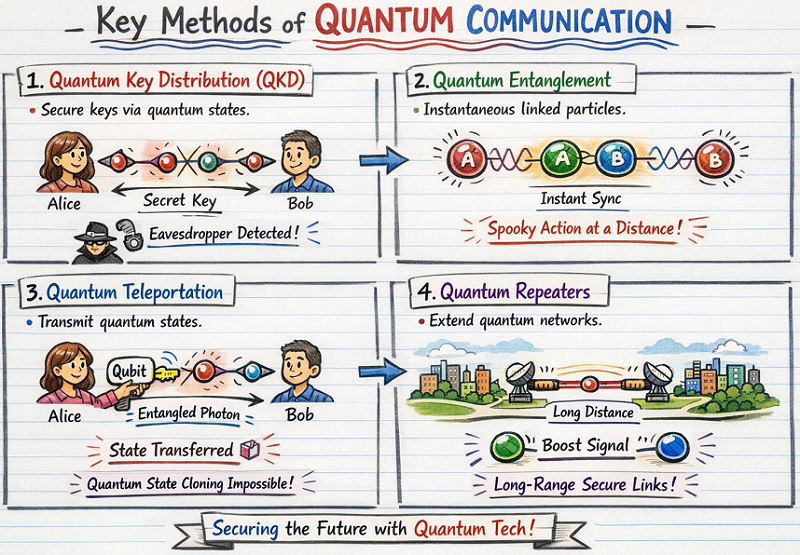
At the heart of most quantum communication systems lies Quantum Key Distribution (QKD). It’s not about sending the message itself via quantum states, but about securely distributing the cryptographic key used to encrypt and decrypt it.
-
How It Works: QKD typically uses individual photons (particles of light) to represent bits of data. These photons are prepared in specific quantum states, such as polarization.
-
The Power of Observation: A core principle of quantum mechanics—the Heisenberg Uncertainty Principle—states that measuring a quantum system inevitably disturbs it. Therefore, if an eavesdropper (traditionally called “Eve”) tries to intercept the quantum key, she will introduce detectable anomalies and errors.
-
The Outcome: The legitimate users (Alice and Bob) can detect the presence of an eavesdropper, discard the compromised key, and start over. This allows for the creation of a key that is provably secure, guaranteed by the laws of physics, not just computational complexity.
Quantum Entanglement: The “Spooky” Superhighway
While some QKD protocols don’t require it, the most fascinating resource in quantum communication is entanglement. When two particles become entangled, they share a quantum connection. Measuring the state of one instantly determines the state of the other, no matter how far apart they are—a phenomenon Einstein famously called “spooky action at a distance.”
-
Enabling Technologies: Entanglement enables advanced protocols like Quantum Teleportation (the transfer of a quantum state from one location to another) and forms the backbone of the future Quantum Internet.
-
The Quantum Internet Vision: This future network would link quantum computers, sensors, and communication devices, allowing them to perform tasks impossible for today’s classical internet, such as distributed quantum computing and enhanced sensor networks.
From Lab to Real World: Current Applications and Milestones
Quantum communication is no longer just theoretical. Significant milestones mark its transition into practical use:
-
Satellite-Based QKD: China’s Micius satellite made history by performing intercontinental quantum-secured video calls between Beijing and Vienna. Satellites are crucial for overcoming the distance limitations of fiber-optic cables, where photons get absorbed.
-
Metropolitan Quantum Networks: Cities like Vienna, Tokyo, and Washington D.C. have operational fiber-based QKD networks securing communication between government buildings, data centers, and research institutions.
-
Banking and Finance: Several major banks are trialing QKD to protect high-value financial transactions and secure data transfer between branches.
The Challenges on the Horizon
Despite its promise, quantum communication faces significant hurdles:
-
Distance Limitations: Photon loss in optical fibers limits terrestrial QKD to a few hundred kilometers. While quantum repeaters are in development, they are not yet commercially viable.
-
Speed and Cost: Current QKD systems have lower key generation rates compared to classical methods and involve expensive, specialized hardware.
-
System Security: While the protocol is physics-secure, imperfections in the physical devices (like photon sources and detectors) can create vulnerabilities, a field known as Quantum Hacking.
The Road Ahead: Integration and a Quantum-Secure World
The future of quantum communication is not about completely replacing the classical internet, but integrating with it.
-
Hybrid Networks: Quantum channels will likely be used for distributing ultra-secure keys, while encrypted data itself travels via high-speed classical channels.
-
Post-Quantum Cryptography (PQC): It’s important to distinguish QKD from PQC—a field developing new classical encryption algorithms that are resistant to attacks from future quantum computers. Both QKD and PQC are seen as complementary solutions for the quantum threat.
-
A Global Quantum Web: The long-term vision is a global quantum communication infrastructure, combining fiber networks, satellite links, and eventually quantum repeaters to create an unhackable communication layer for the world’s most sensitive data.
🔰 𝐃𝐨𝐰𝐧𝐥𝐨𝐚𝐝 𝐩𝐝𝐟 𝐁𝐫𝐨𝐜𝐡𝐮𝐫𝐞: https://www.marketresearchfuture.com/sample_request/12240