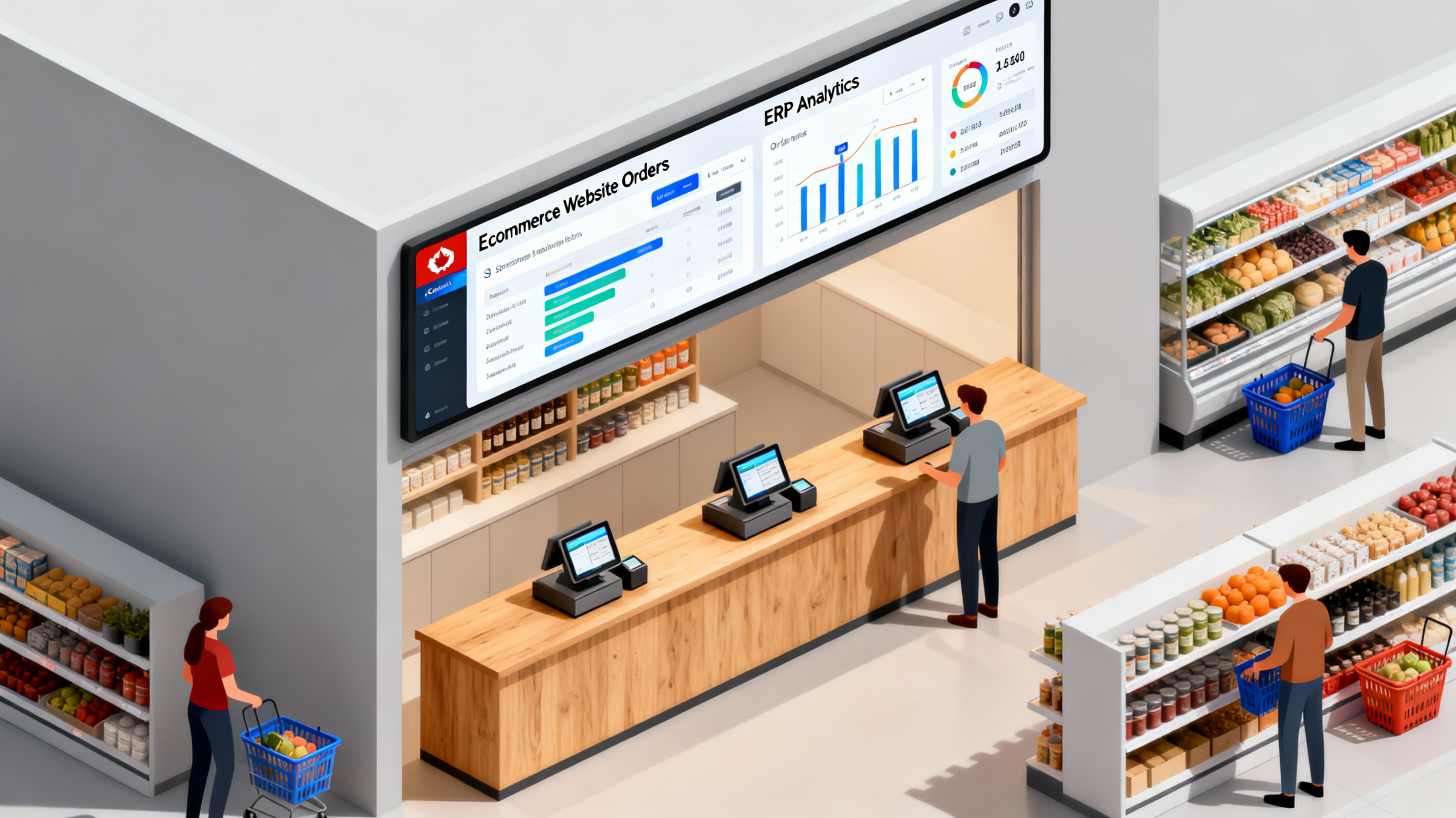
Enterprise Resource Planning (ERP) is the “control center” that keeps your point of sale, ecommerce website, warehouse, and finance systems working together instead of in silos. For Canadian retailers, restaurants, and salons, a unified ERP system like Baseer’s Retail OS can remove manual work, reduce stock issues, and create a smoother experience for both staff and customers.
What ERP Means in Retail
An ERP system in retail is a central database that connects POS, ecommerce, inventory, purchasing, accounting, and sometimes HR. Instead of re‑entering data across multiple tools, your team works from one shared source of truth.
With Baseer, ERP sits under the same roof as POS, ecommerce solutions, mobile app, and warehouse management, so you are not integrating five vendors just to get basic visibility.
Why POS and Ecommerce Often Feel “Broken”
Many Canadian SMBs start with a basic point of sale in‑store and a separate ecommerce website for online orders. Over time, problems appear:
- Inventory is wrong because each system tracks stock separately
- Staff copy online orders into the POS system manually
- Promotions and price changes have to be updated twice
These issues lead to out‑of‑stocks, double‑selling, and frustrated customers who see different information online and in‑store.
How ERP Fixes Data Fragmentation
When POS and ecommerce run on a shared ERP:
- Products and prices live in one catalog, then sync to the POS and ecommerce store automatically
- Stock levels update in real time as items sell in‑store, online, or through a mobile app
- Orders and returns are recorded in a single place, ready for fulfillment and accounting
Baseer’s unified data model does exactly this by connecting POS, ecommerce, ERP, WMS, and mobile into one stack.
Real‑Life Example: Independent Grocery
Consider an independent grocery in Toronto using separate systems for in‑store checkout and online delivery. Every night, staff export ecommerce orders, adjust inventory by hand, and update prices manually on the website.
After moving to Baseer:
- The POS system, ecommerce website, and ERP share the same catalog
- Stock updates automatically as customers buy from the store, mobile app, or online
- Managers see real‑time sales and inventory reports for both channels in one dashboard
This reduces shrink, improves stock accuracy, and frees up staff to focus on service rather than data entry.
Operational Wins You Can Expect
With a retail‑ready ERP tied to POS and ecommerce:
- Fewer stockouts and overselling
- Cleaner financial data, because every sale flows into one ERP system
- Faster staff training, since they learn one connected platform instead of multiple logins
Baseer also adds AI forecasting on top of this shared data, helping grocers and specialty retailers plan purchasing more accurately.
Omnichannel Starts With the ERP
True omnichannel commerce where customers can buy online, pick up in‑store, or reorder from a mobile app only works when all channels talk to the same ERP. Baseer synchronizes inventory, customers, and orders across point of sale, ecommerce stores, marketplaces, and social commerce in real time.
A unified ERP‑driven commerce stack is what turns scattered sales channels into one coherent business that can scale.