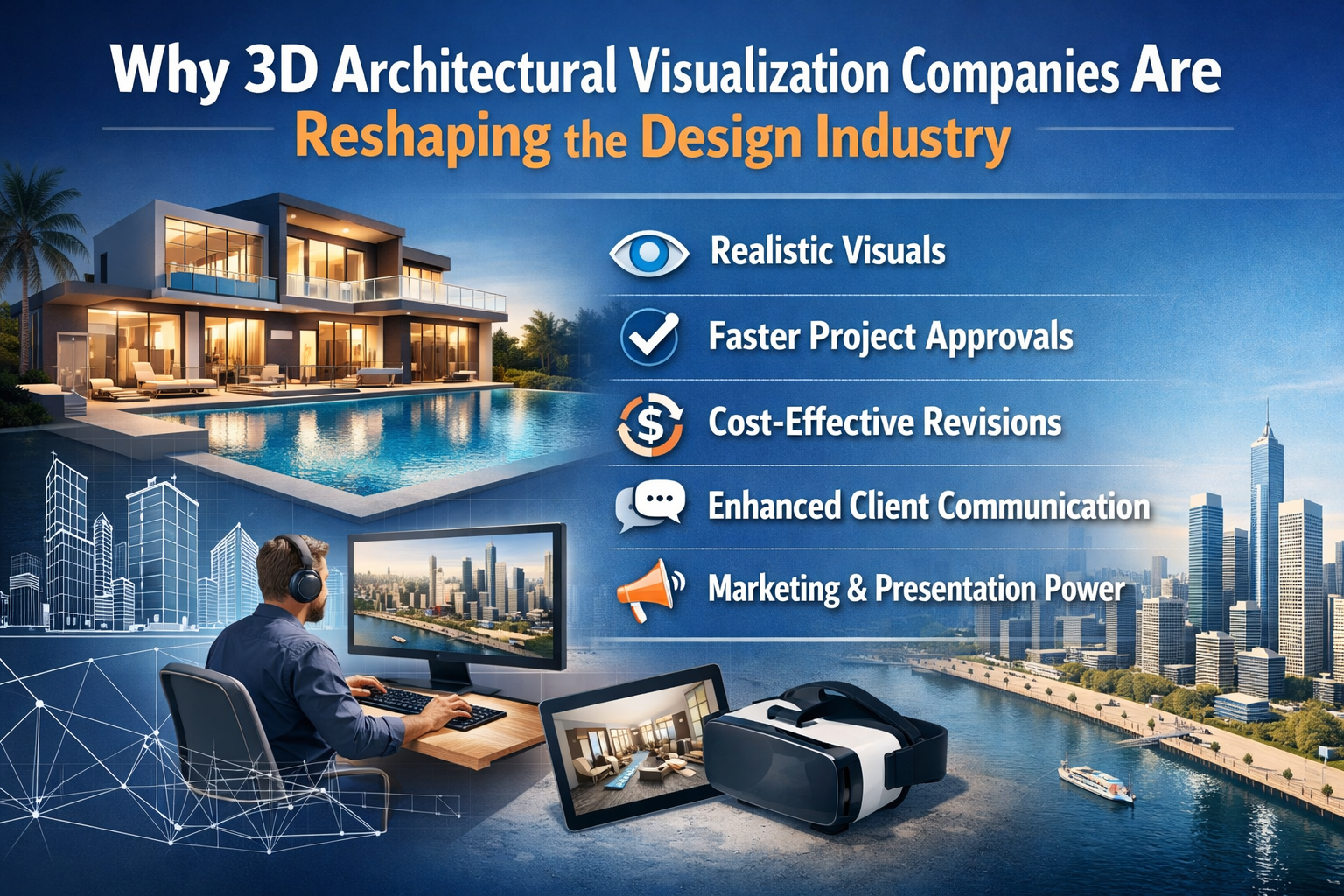
The design and construction industry is taking its first steps into one of the most revolutionary phases. While clients require more explanation, designers research increasingly complex tools, and developers want to avoid risks as much as possible, the role of architectural visualization companies becomes very important.
With an innovative digital toolset, an artistic and technical team transforms architectural concepts into immersive and photorealistic experiences. This is something which was considered an optional element in design workflows but is now a cornerstone within today’s modern architectural practice.
While most people’s perceptions of architectural visualization are basic sketches or simple 3D layouts, the reality is so much more: interactive walkthroughs, VR tours, animated flyovers, and hyper-realistic renders that show every nuance of the project. This, in turn, gives the client and other stakeholders an infinitely more cogent understanding of the design intent, thus enabling confident decisions in the seamless execution of a project.
Times continue to change, and so does the difference that these visualization companies bring about in reshaping how ideas are iterated, how they are communicated, and how those ideas come into being.
The following goes into detail on how these companies are reimagining the design landscape and why their services have turned so critical across architecture, engineering, and real estate.
1. Bridging the Gap between Imagination and Reality
One problem in architectural design is trying to help a client understand space before it exists. Traditionally handled with hand drawings or 2D plans, there is much left to interpretation, and therefore, confusion and uncertainty. Architectural visualization companies solve this problem by taking raw concepts and turning them into highly detailed digital environments.
Advanced rendering techniques allow the designer to show textures, lighting, material, and structural form in very realistic ways. Clear visuals guarantee that the client can really “see” what the end result will be. The enhanced visualization reduces misunderstandings and makes sure that everyone is on the same page.
2. Better Communication Within Project Teams
Large architectural projects involve many collaborators: designers, engineers, contractors, and clients. There is a great need for coordination in all activities. Poor communication results in delayed timelines, inflated costs, and even design conflicts.
It is that universal language that every individual understands so easily. A team working for a 3D architectural visualization company prepares highly accurate models, enabling smooth discussions in the alignment of improvements to projects. It is shared visuals that act as a base on which the stakeholders give precise feedback and drive more informed decisions with much less friction.
3. Faster, More Confident Decisions
It is also really tough for the clients to compare different design options when the project is in an early stage. Architectural visualization eliminates this problem; one can present several variations side by side. Be it color schemes, furniture arrangement, or façade materials, each different choice is in clear, realistic view.
Visual support of this type expedites the entire approval cycle and gives confidence to decision-makers to commit to choices. Quicker approvals translate into shorter timelines for projects and smoother workflows for architects and developers.
4. Reduce Design Errors Before Construction Starts
The most costly design errors are those found during the construction stage. These usually need rework, extra material, and rescheduling of labor factors, which tend to drive up project costs.
This solves the problems much quicker. From layout conflicts to lighting inefficiencies, or even structural inconsistencies, issues are exposed long before the physical work actually starts by the digital models. Architecture visualization companies make sure the flaws in the designs are known and corrected well in advance in order to save the budget and timeline.
5. Revolutionizing Real Estate Marketing
In the highly competitive real estate market today, developers need every kind of dazzling tool that will actually be looked at by buyers, from photorealistic renders to interactive tours, exterior flyovers, and more. It is all just about creating effective marketing content.
That’s when people can really imagine a project they’re going to invest in. Realistic imagery builds trust and speaks to quality, even for those properties that are under construction. Now that browsing on the web is the favorite mode of finding property, polished visualizations have become integral to online marketing strategies.
6. Immersive Visual Experiences Drive Engagement
Yet today, with virtual and augmented reality, even interactive 3D walkthroughs are increasingly becoming a regular feature of presentations from the design team. Visualization is about so much more than images.
The immersive experience allows clients to walk through properties and explore rooms in real time to understand the flow of space themselves. This increases satisfaction for the clients and makes the overall presentation memorable. A well-executed immersive showcase differentiates firms and shows technical excellence.
7. Collaboration Across Global Teams
As more people are working remotely, collaborative efforts span across borders, creating a totally different set of challenges amongst architectural teams. Visualization solutions actually tear down the barriers of distance by offering digital models that can be shared, reviewed, and revised by any collaborator around the world.
The architect and the client can review designs virtually, explore refreshed renderings, and refine their concepts-all in a non-face-to-face manner. That freedom greatly accelerates project progress and lets design work continue, unimpeded, across time zones.
8. Simplification of Design-to-Construction Process
Visualization ties everything from design conception to execution on site, and correctly guides the contractors and construction teams through the digital models at every stage of the build. This, in turn, further reduces ambiguity and supports the fact that what was constructed is exactly the structure intended by design.
Final Thoughts
But architectural visualization companies are increasingly driving change throughout the entire design industry: from better communication and fewer mistakes, to more effective marketing in support of truly innovative design thinking. Companies learning how to use these kinds of tools will lead the future of architectural design in making available not only functional and beautiful but also deeply understood spaces, well before the first brick is laid.